
Finding Corpus Christi Residents
Begin with the record that is tied to the detail in hand. A street address works well in the Nueces Central Appraisal District search, while a recorded name can lead to a deed or lien in the county index. A person who appears in an older household may be easier to place through a city directory, yearbook, obituary index, or newspaper microfilm. Corpus Christi records are held by separate city, county, and state custodians. That split is useful because two independent records can confirm a name, address, date, or relationship without assuming that one result tells the whole story.
Property ownership is not the same as occupancy. A mailing address can differ from the parcel address, voter information is subject to protections, and a court party listing is not proof of a current home. Use a dated record as a time-stamped lead, then compare it with another source. The steps below keep a Corpus Christi residents directory search focused and factual.
- Search the appraisal district by owner name, street number and street name, or a property identifier.
- Compare the parcel’s situs address, mailing address, legal description, and tax-year information.
- Search the County Clerk’s official-record index for a matching grantor, grantee, subdivision, document type, or document number.
- For an older household, ask the Local History Department for the relevant directory, obituary, yearbook, or microfilm route.
- When no index exposes the needed government record, make a focused request to the custodian under the Texas Public Information Act.
Corpus Christi Resident Records Offices
The County Clerk, appraisal district, City Secretary, District Clerk, and Texas elections office each keep a different part of the trail. The County Clerk records deeds, liens, plats, marriage records, and other official instruments. Nueces CAD connects an owner or address to a parcel account, legal description, values, and exemptions. The City Secretary routes city records and requests that are not posted online. For a whole-address workflow, the Corpus Christi street directory keeps the parcel, GIS, deed, and permit steps in one sequence.
Nueces County Clerk
901 Leopard St., Room 201
Corpus Christi, TX
Official records and local vital routes
Nueces Central Appraisal District
Owner, address, and parcel evidence
Corpus Christi area property search
Public portal, verify preliminary values
Texas Elections Lookup
Registration-status and VUID route
Use name, county, date of birth, and ZIP
Protected records can be suppressed
Corpus Christi Property Roll Search
Nueces CAD is the practical starting point when a Corpus Christi residents directory search begins with land or an address. Its By Owner and Advanced routes accept an owner name in last-name, first-name order, as well as street number, street name, property ID, geographic ID, subdivision, condo, property type, tax year, and other filters. The Street Name field is meant to omit the prefix, suffix, and unit number. Try a simple name or street term before adding filters. The portal can show an owner, mailing address, situs address, property identifiers, value, exemptions, legal description, and tax-year material.
The appraisal district cautions that 2026 values are preliminary and that legal descriptions and acreage are appraisal information to verify. A parcel is a recorded piece of land; its situs address is the physical location used for the property. Neither field establishes every person in a household.
| Nueces CAD field | Use in a resident search | Format note |
|---|---|---|
| Owner Name | Find a named ownership record | Last name first, such as Smith John |
| Street Number and Street Name | Locate a specific parcel | Leave prefixes, suffixes, and units out of Street Name |
| Property or Geographic ID | Return to one parcel | Useful after a map or prior result supplies an identifier |
| Tax Year | Compare appraisal material by year | Values can change and require verification |
The Nueces County Official Records Quick Search below is the next stop once a parcel result supplies a name or legal description.
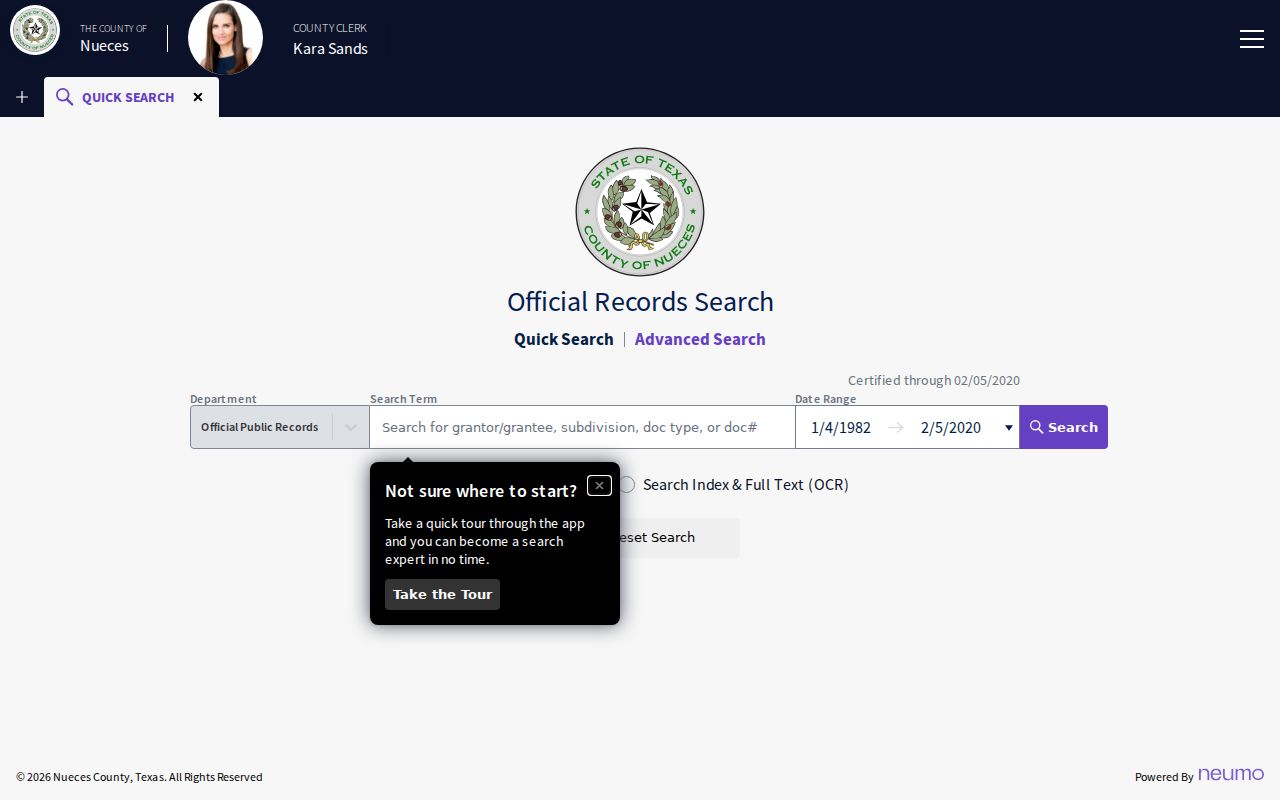
Move from the property result to the deed index when the question is ownership history rather than current parcel data.
Corpus Christi Resident Deed Index
The Nueces County Clerk’s current GovOS official-record search has Quick Search and Advanced Search tabs. Quick Search accepts a term for grantor or grantee, subdivision, document type, or document number. It also offers recorded-date fields, preset date ranges, and a choice between the index only and index plus full-text OCR. Two words are matched separately in the index, while an exact phrase is used for OCR. A Corpus Christi residents directory search involving a property party should confirm current coverage with the clerk before relying on a date boundary.
Older work follows a different system. The Kofile Historic Index Books use document type, year, direct or reverse parties, then alphabetic last-name and first-name controls. Deeds run from 1847 through 1972 in the observed series, and the Real Property series covers 1973 through 1982. The portal is a 24-hour research route, while copies can also be requested through the County Clerk’s Corpus Christi or Robstown counter or by phone.
| Current GovOS search | Historic Kofile books |
|---|---|
| Modern quick term, dates, index or OCR controls | Type, year, direct/reverse party, and alphabetic name controls |
| Useful for a current official-record lead | Useful for older deed-chain and index-book research |
Pair a deed-party result with a parcel or other dated evidence before treating two same-named people as one person.
Corpus Christi Voter Record Limits
Texas My Voter Portal can locate a registration record with a name, county, date of birth, and ZIP, or with a VUID. It helps confirm registration status or a VUID for a person who supplies the required information. It is not a street-browsable public roster. The separately requested statewide voter file has its own affidavit, fee, delivery, and use rules. Nueces County’s Tax Assessor-Collector provides voter-registration help, but directs the actual name and VUID lookup to the Secretary of State.
Texas Election Code protections can suppress a protected voter’s details. The Address Confidentiality Program is separate and provides an eligible participant a substitute mailing address. A 2026 Secretary of State advisory also warns that portal results can display asterisks for a suppressed voter. Do not try to work around a suppression by joining unrelated records. A person’s safety restriction belongs with the custodian process.
The Texas My Voter Portal is the official lookup shown here.
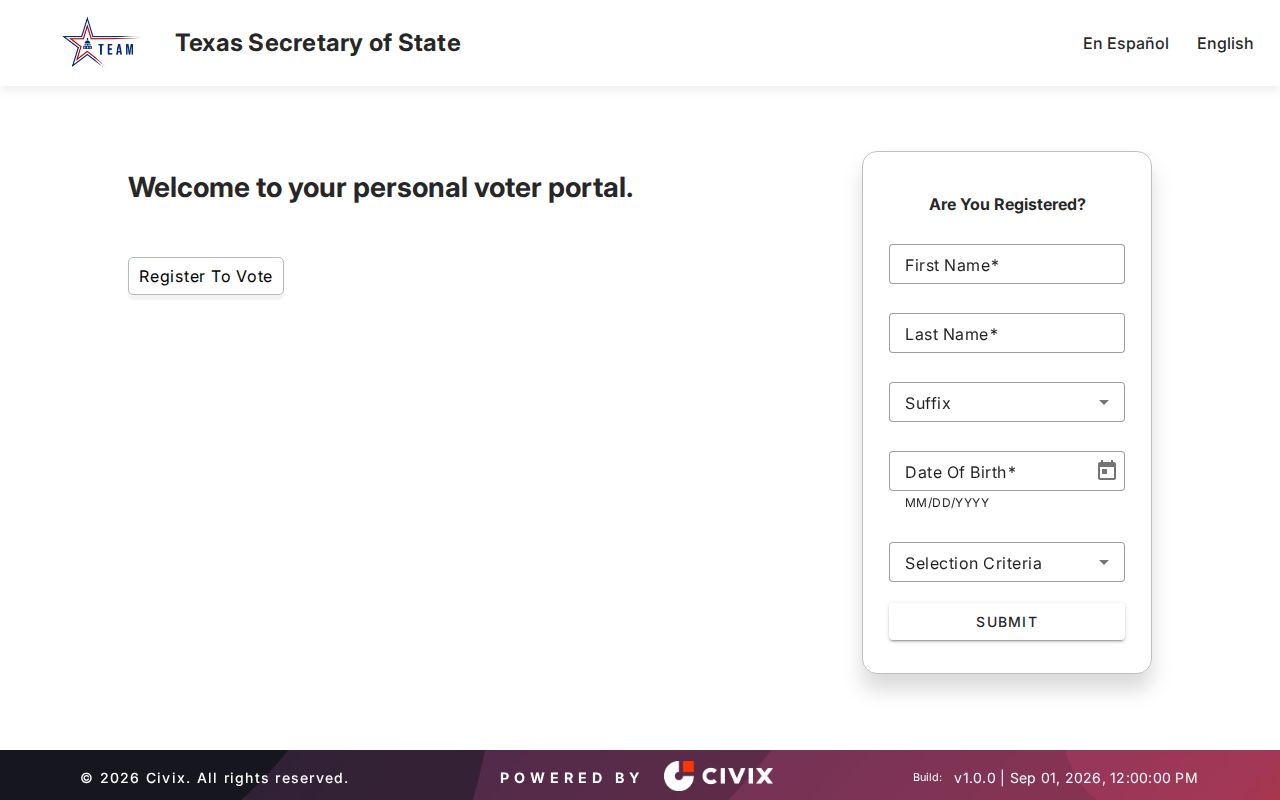
Portal access is distinct from the separately requested statewide voter file and its use rules.
Current Corpus Christi Resident Directories
There is no one current roll of every Corpus Christi household. Instead, Corpus Christi residents directory sources identify people in a particular relationship to a parcel, recorded instrument, registration record, city permit, court case, or organization. That distinction matters. An official match is strongest when it states what role the record actually documents, such as owner, grantor, grantee, registered voter, permit applicant, or court party.
| Source | Who It Lists | Keeper | Access |
|---|---|---|---|
| Property roll | Parcel owners and address evidence | Nueces CAD | Public owner/address search |
| My Voter Portal | Registration-status or VUID match | Texas Secretary of State | Identity-input lookup; suppression rules apply |
| Official-record index | Parties to deeds, liens, plats, and instruments | Nueces County Clerk | GovOS current index and historic books |
| Dynamic Portal | Permit applicant or contractor at an address | City Development Services | Anonymous address lookup for permits |
| Local History collections | Older residents, households, and community context | Corpus Christi Public Libraries | In-library and catalog routes |
The property roll is best for a parcel owner, and the official-record index is best for named instrument parties. A permit result can place construction activity at an address but does not establish a household. A one-person check should compare independent records and respect each source’s limits.
Corpus Christi Court and Vital Checks
A court search can verify that a named party appears in a particular case, but it does not establish a residence by itself. Nueces District Clerk Smart Search accepts a case number or party name, with advanced filters for name type, date of birth range, case type, status, date, judicial officer, and location. Results group by party and can show a party name, date of birth, and case number. Re:SearchTX is the document layer, and the county says recent civil and family documents can appear there within minutes at 10 cents per page. Paper requests and courthouse access remain necessary when an online result is incomplete.
Vital records call for the same care. The City Secretary issues eligible Corpus Christi birth and death certificates, the County Clerk supplies marriage routes and some local short-form records, and DSHS maintains statewide certificates, verifications, and indexes. Texas Government Code §552.115 restricts birth certificates for 75 years and death certificates for 25 years. An index entry or verification is not a certified certificate.
The Texas court document portal is shown here for the court layer.
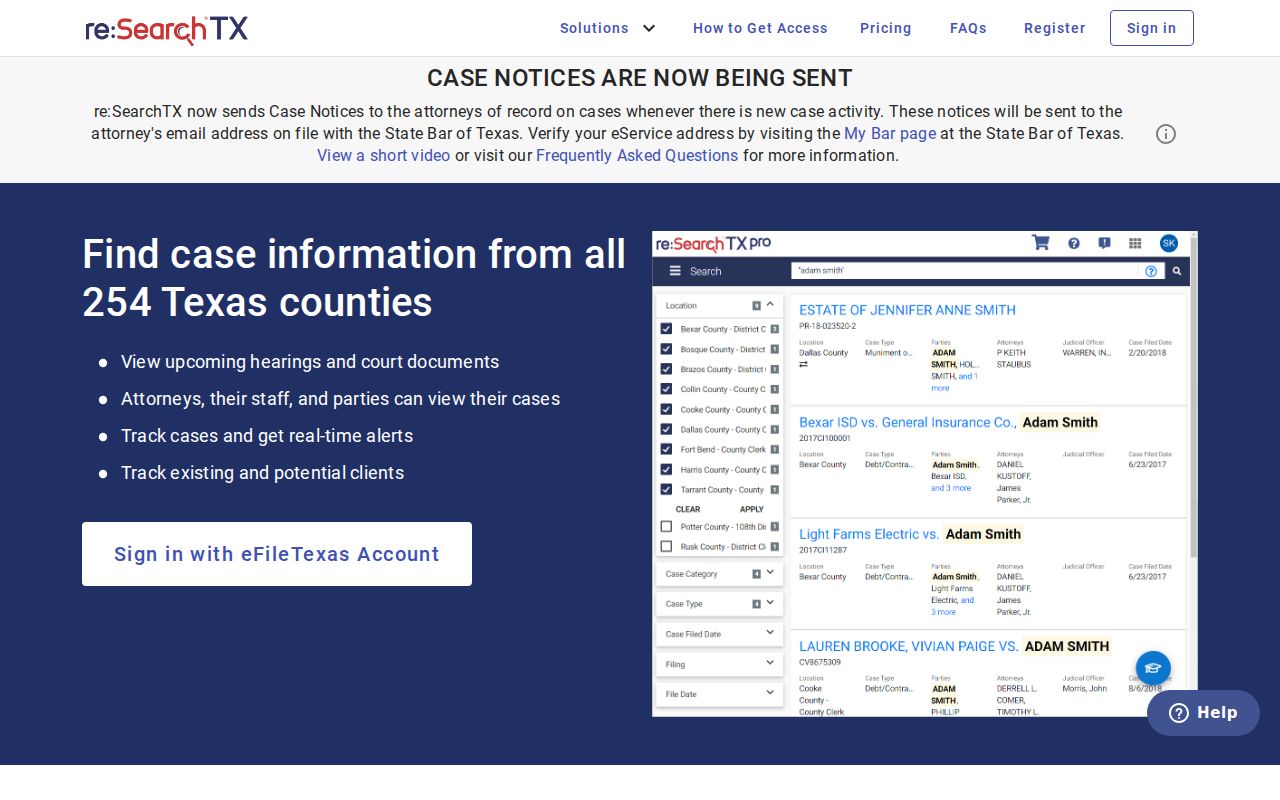
For a local vital request, start with the Corpus Christi birth and death certificate instructions.

State marriage and divorce indexes begin in 1966 and 1968 respectively, but certified marriage copies come from the County Clerk and divorce decrees from the District Clerk.
Corpus Christi Resident Permit Evidence
The City Development Services Dynamic Portal is an address-keyed source for building activity. Anonymous users can search by address, permit number, or a permit date range. The research documents inspection-date searching and available inspection details, comments, fees, documents, and permit-card printing. Account sign-in is needed for application and action workflows. A Corpus Christi residents directory result from a permit can identify an applicant or contractor and date a project, but it does not prove who occupied the property.
The Corpus Christi Dynamic Portal is shown in this capture.

When an online portal has no result, the City Secretary’s public-records route is the proper fallback. The city form asks for contact details, a focused description, department when known, a date range, and an expedited-release choice. A narrow request is easier for a custodian to locate and review.
The Corpus Christi public-records landing page documents that city route.

Corpus Christi Resident ZIP Clues
ZIP geography helps narrow a search, but it should not be used as proof of a city limit or parcel location. USPS ZIP assignments, Census ZCTAs, Nueces County jurisdiction, city service areas, and a parcel’s situs address are different geographic systems. The USPS Location Finder accepts street, city, state, or ZIP inputs and can filter locations by type. Compare an exact address with the postal result before using a ZIP as a search term.
The USPS location and ZIP tool illustrates the postal starting point.
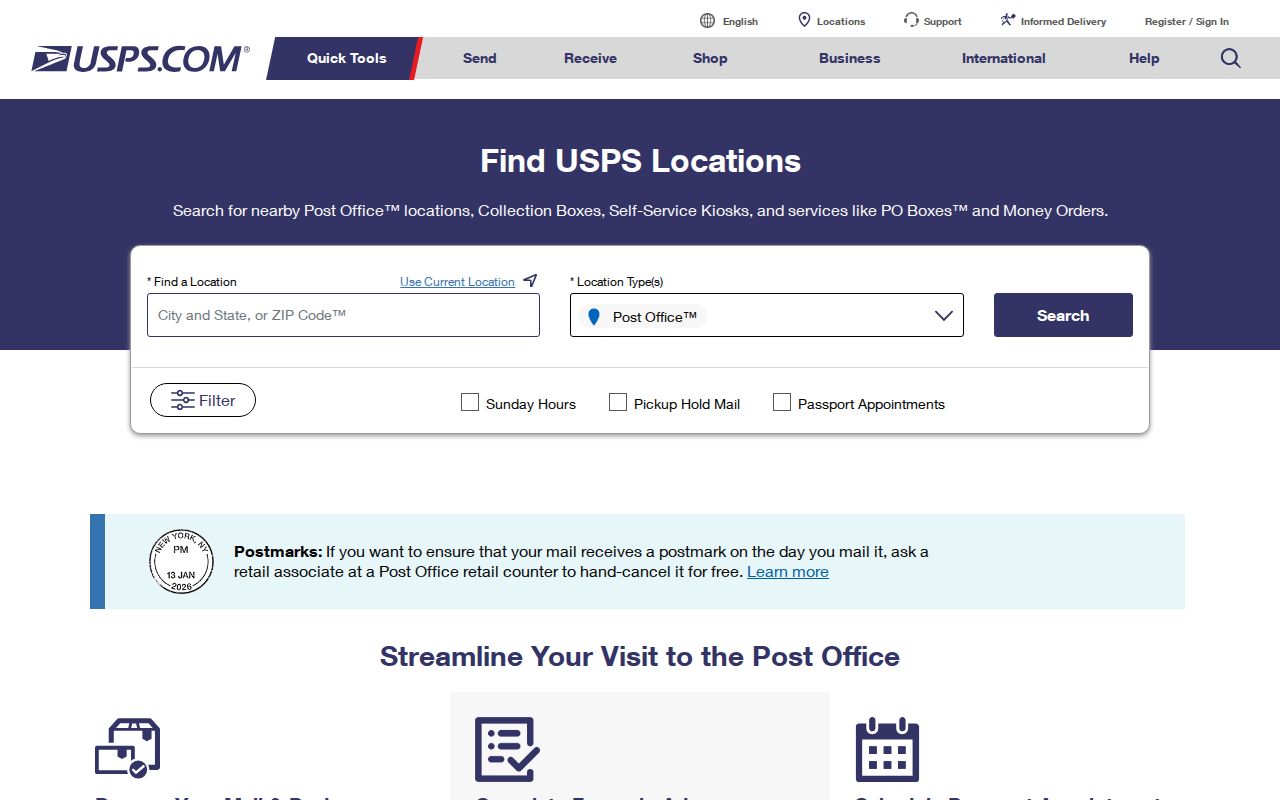
Downtown, Six Points, Stonewall, and Flour Bluff postal processing groupings are useful search hints, not neighborhood boundaries. The ZIP code directory gives the fuller ZIP-by-ZIP method.
Historical Corpus Christi Resident Directories
Older Corpus Christi residents appear in more than one directory run. The Texas State Library lists city directories from 1913-14 through 1993 with gaps, so the list should not be read as an unbroken annual series. UT’s catalog identifies a January 1911 Southwestern Directory Company volume with city, business, and residential portions, while the Southwestern Bell collection covers telephone directories from 1909 through 1991. A city directory and a telephone directory are related but different sources, and their year runs should not be merged.
La Retama Central’s Local History Department holds Corpus Christi, Texas, genealogy, Hispanic genealogy, yearbooks, directories, funeral arrangements, family files, organization files, photographs, scrapbooks, and local material. Fragile material is non-loan, and copying is case by case. UT’s WPA finding aid also includes a Corpus Christi City Guide, Parts I and II, among records from 1935 through 1945. The full collection, entry-reading, and year-by-year tracing method is on the Corpus Christi city directory page.
Corpus Christi Resident Obituary Index
The Corpus Christi Public Libraries obituary index contains several hundred thousand notices, but it is arranged by publication date rather than date of death. Search a window around the likely publication date, then use a vital index, probate trail, or directory year to confirm the connection. For an earlier Corpus Christi residents directory trail, the Local History Department also supplies newspaper microfilm, yearbooks, family files, and staff help with limited-access resources. Its collections can explain a household record that does not appear in a current portal.
A Texas State Library microfilm guide adds another early-record route: it lists Nueces material that includes marriage records from 1846, deeds from 1847, district-court minutes from 1850, naturalization from 1852, and voter-registration lists from 1867 through 1872. These are archival leads, not proof that every item can be searched from home.
Corpus Christi Privacy and Record Safety
Texas records have real access limits. DMV address data is constrained by the federal Driver’s Privacy Protection Act, sealed and expunged court material may not appear in a public result, and vital certificates have statutory confidentiality periods. Texas Election Code rules govern confidential voter fields and prohibited voter-file uses. The Texas Address Confidentiality Program protects eligible participants through a substitute mailing address. A visible record does not cancel a separate safety protection.
Use the custodian’s correction, request, or confidentiality process when it applies. The County Clerk also says its Property Fraud Alert has been free since 2023, a useful check when a property owner receives a suspicious deed-copy or recording solicitation. Confirm a notice through the clerk instead of paying an unsolicited sender.