
Corpus Christi City Directory Holdings
The historical shelf is spread across local, state, university, and catalog collections. That split matters. A title listed in a catalog may be a repository lead rather than an online scan, while a local microfilm run can be consulted only under library rules. The Texas State Library list is the clearest locator for the main local directory run. University catalogs add the earlier 1911 volume and telephone books, and FamilySearch identifies a separate 1951 volume. Keep the publication type with the citation, because a telephone book and a residential listing source answer related but different questions.
| Collection | Years | Where Held | Access |
|---|---|---|---|
| Main local directory run | 1913-14; 1923-24; 1929; 1937; 1939; 1941; 1944; 1946; 1948-49; 1951; 1953; 1955-86 except 1970; 1987-93 | Texas State Library list; CCPL Local History | Shelf or copy access; digitization varies |
| Southwestern Directory Company volume | January 1911 | UT Center for American History directory catalog | Catalog record; confirm scan access with repository |
| C.B. Page Directory Company | 1951 | FamilySearch catalog | One-volume catalog record with digital-link status |
| Southwestern Bell telephone books | 1909-1991; annual 1960-84 | UT Center for American History | Telephone, residential, and business clues; listed gaps apply |
These are listed runs, not an assurance of annual completeness. The state list omits 1970 from the 1955-86 sequence, and its final listed city-directory years are 1989-93. The university’s phone-book list extends later, but that does not turn it into a continuous city-directory series.
Access also changes from one title to another. The Texas State Library list is a locator, not a promise of a digital scan. The 1911 UT record is bibliographic evidence until repository access is confirmed. FamilySearch identifies the 1951 C.B. Page item as a one-volume catalog record with a digital-link status to check. At La Retama, staff can help with FamilySearch and limited-access resources, while fragile local material remains non-loan. Record the catalog source and the access channel along with the year, especially when a search has to move from an online catalog to a library shelf or microfilm reader.
Corpus Christi Directory Years in Context
Publication history gives the research trail its shape. The earliest cataloged volume is the January 1911 Southwestern Directory Company item. The Corpus Christi city directory calendar then lists 1913-14 and scattered later years, not one unbroken annual run. Use the dates as checkpoints. A person absent in a gap has not necessarily moved, and a name appearing in a phone book may be a subscriber rather than proof of every household member.
The Texas State Library city-directory list is a practical starting point for checking those Corpus Christi years.
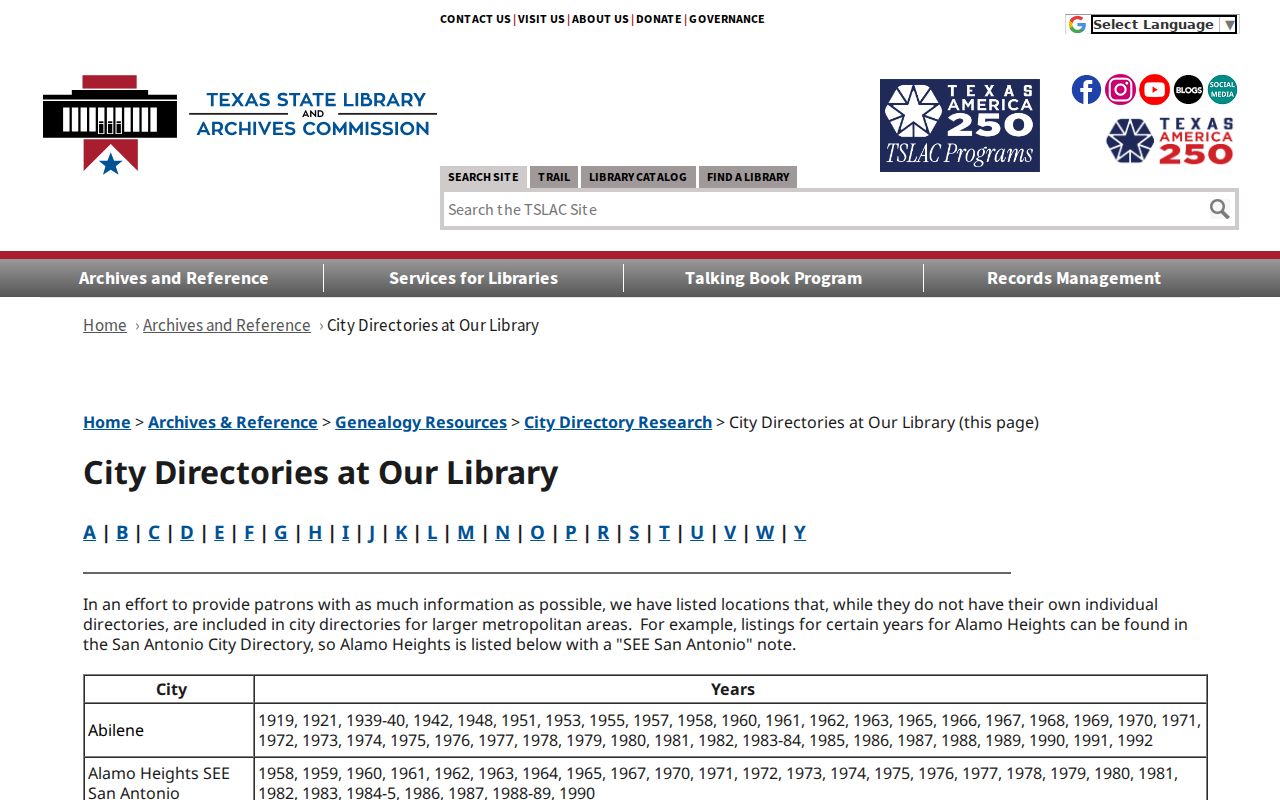
The list helps a researcher choose a likely volume before asking whether the copy is on a shelf, on microfilm, or available through an institution.
- January 1911: UT records the Southwestern Directory Company city, business, and residential volume.
- 1913-14 through 1953: the state list identifies scattered Corpus Christi city-directory years.
- 1955-86: the listed run is broad but excludes 1970.
- 1987-93: later city-directory years appear on the state list, while the UT telephone-book record reaches 1991.
The 1911 Corpus Christi Directory
The UT Center for American History catalog record identifies its 1911 item as City Directory of Corpus Christi, Texas, published by Southwestern Directory Company in Corpus Christi. Its catalog categories are business/commercial, city, and residential, and its locations include Alice, Corpus Christi, and Kingsville. That scope is important when deciding whether a name or address actually belongs to the city being researched.
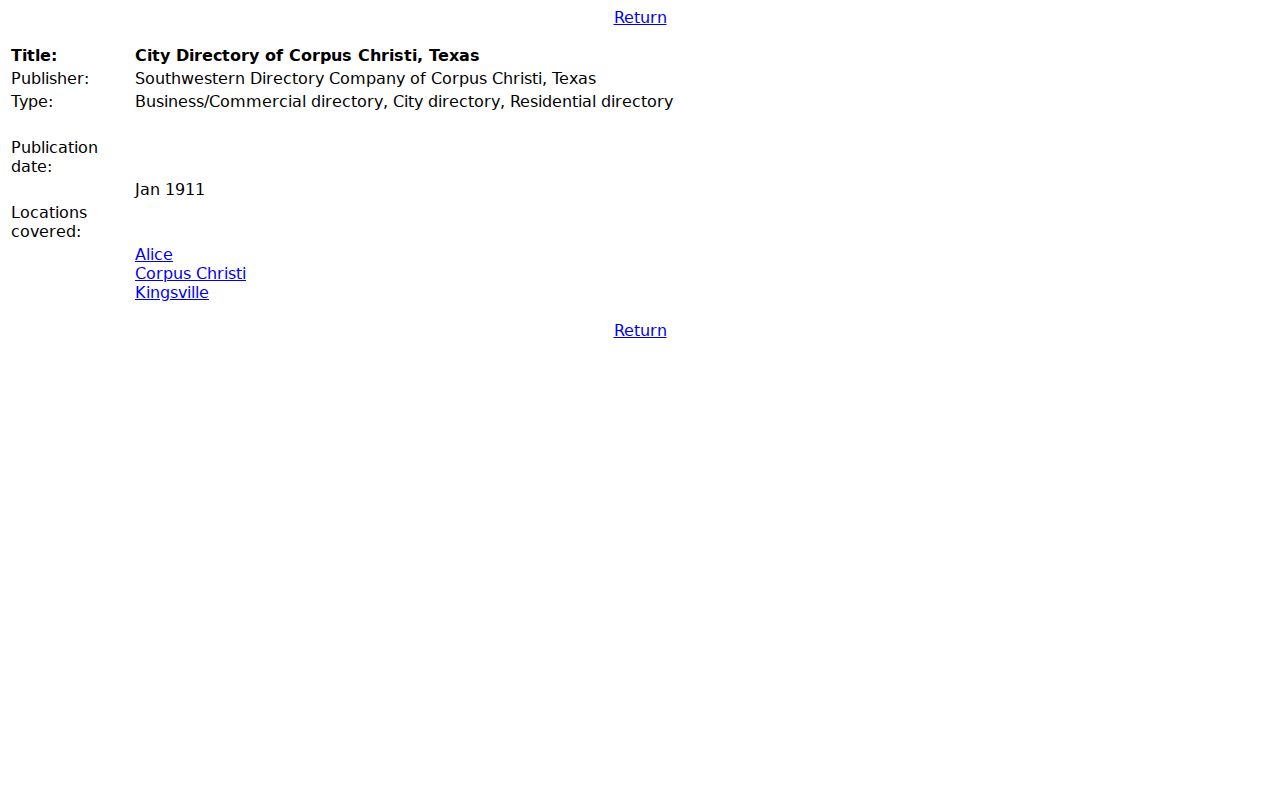
The catalog view establishes publisher, date, type, and place. It does not by itself establish that every page is freely viewable, so repository access should be checked before planning a page-by-page search.
Note: Preserve the title, year, repository, and page or image reference whenever a directory entry becomes part of a family-history trail.
Corpus Christi City Directories at La Retama
La Retama Central Library’s Local History Department is the local working room for directory volumes, telephone directories, yearbooks, funeral arrangements, family files, business and organization files, photographs, scrapbooks, and Caller-Times microfilm. Use the Corpus Christi city directory collection there when a catalog lead needs a shelf, microfilm, or staff-access route. It is on the second floor. Staff can help with FamilySearch and limited-access material, while TexShare databases are available in the library and some are available at home with a library card. Contact the department at LocalHistory@CorpusChristiTX.gov or (361) 826-7030 before a research visit.
CCPL Local History describes the collection and its preservation conditions.
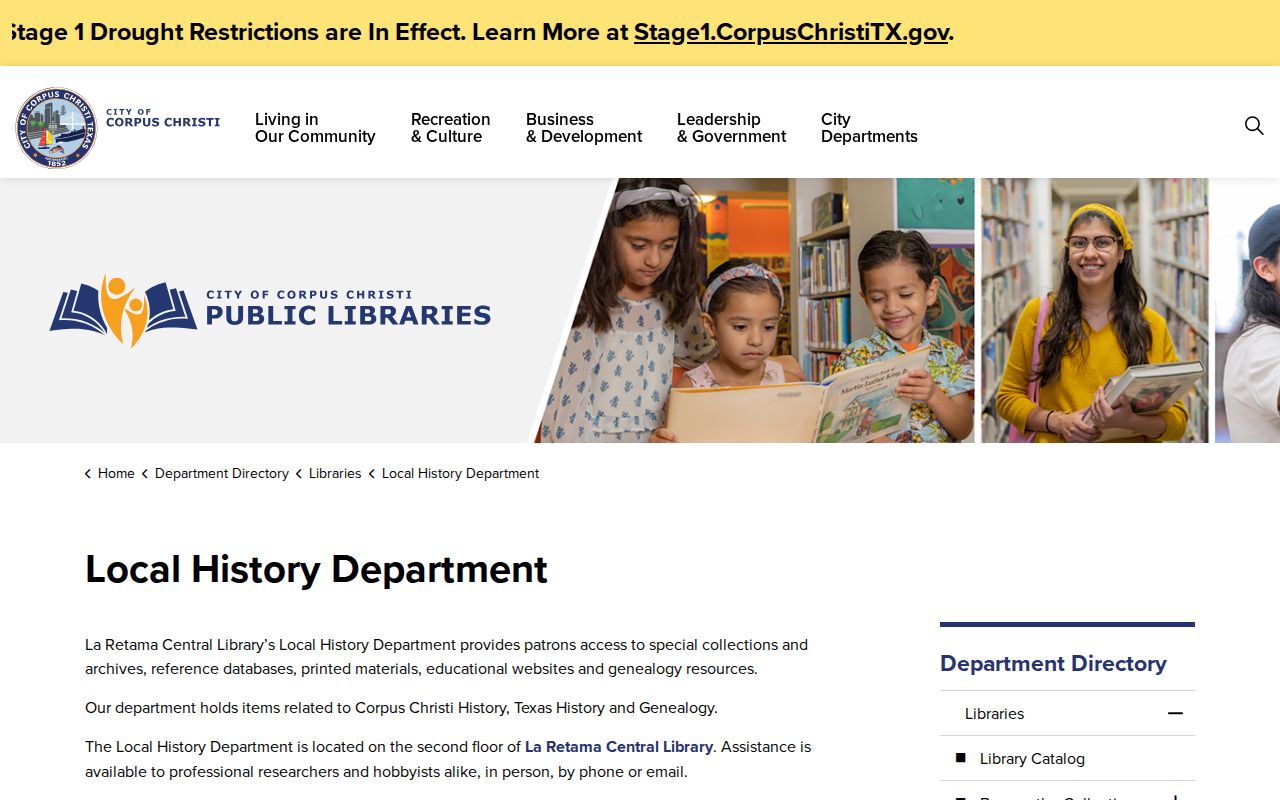
Fragile materials do not circulate. Copying is case-by-case, and black-and-white copies cost 30 cents, so ask about a volume, microfilm reel, and copying permission before relying on a same-day visit.
Reading a Corpus Christi Directory Entry
No open page image was inspected for these Corpus Christi volumes, so the items below are a verification checklist, not a claim that every local volume prints every field. Record the page heading and the publisher as well as the entry. A name may appear as initials, a former surname, or a cross-reference. An address may identify a residence, business, or telephone subscriber. Copy the printed wording first, then interpret it against the volume’s own abbreviation key.
| Name and cross-reference | Capture initials, spelling, suffix, former surname, and any printed “see” reference. |
|---|---|
| Family clue | Note a spouse or relative in parentheses only if the volume actually prints one. |
| Occupation or employer | Copy the words as printed. They can distinguish same-name people but are time-specific. |
| Street address and section | Record the number, street, and whether it is in residential, business, or telephone material. |
| Printed marks | Check for owner, renter, widow, street, avenue, telephone, or occupation abbreviations in that volume’s key. |
- Criss-cross directory
- An address-ordered section, when present, used to move from a street number to an occupant or subscriber clue.
- Householder index
- A name-oriented list that can identify the household contact, not necessarily every person at an address.
- Abbreviation key
- The volume’s printed explanation of shortened words or marks. Photograph or transcribe it before inferring a meaning.
Where a Corpus Christi volume includes more than one section, preserve which section produced the name. A residential listing, business listing, and telephone entry can describe different kinds of connection to the same address.
Corpus Christi Telephone Directory Runs
The UT catalog’s Southwestern Bell record is a companion shelf, not a replacement for the local historical volumes. It lists Corpus Christi, Portland, and Robstown telephone books from 1909 through 1991, with annual coverage shown from May 1960 through May 1984 and additional dated issues around it. Telephone, residential, and business listings can put a name near an address, but they can also reflect the person or organization that held the service.
For a local collection lead, the Nueces County Historical Society collection description documents materials contributed by local historians and collectors. It does not publish an individual-name index or a research-fee schedule.
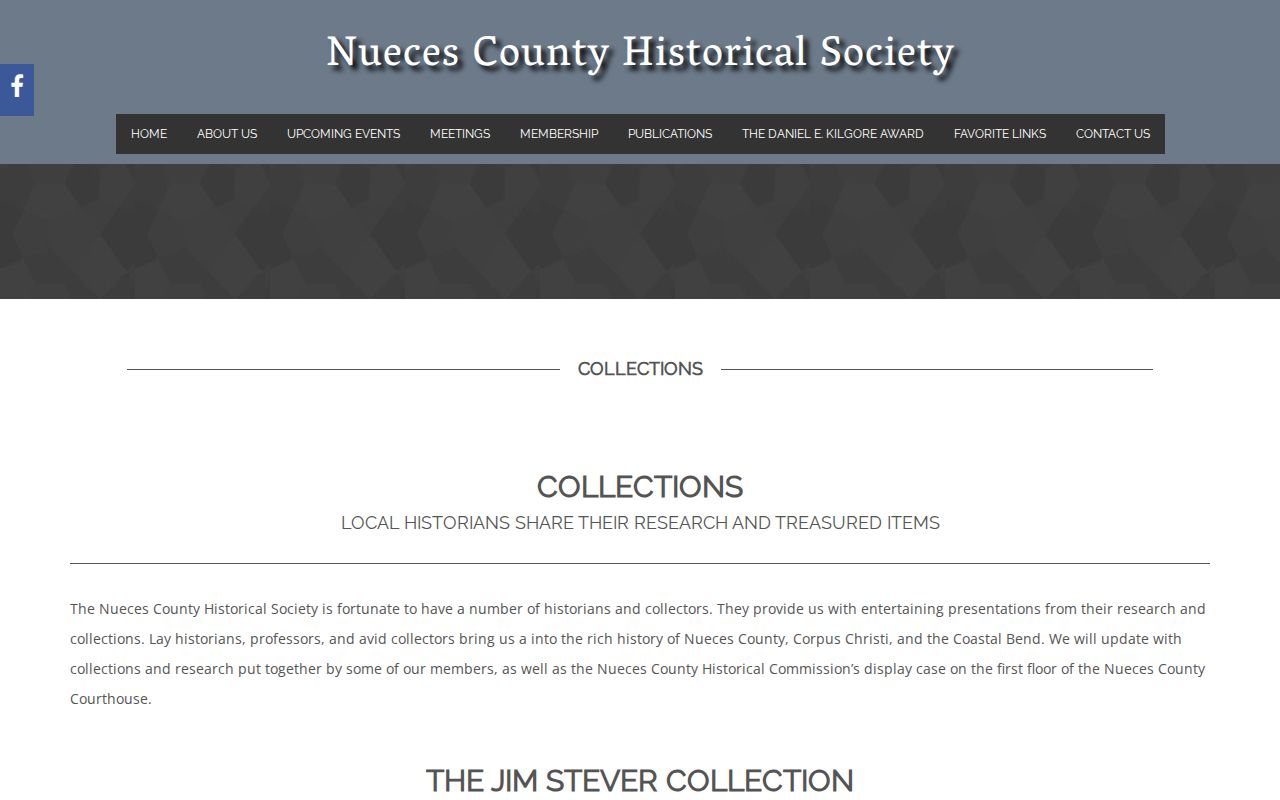
The historical society is a useful referral and collection lead. Confirm the relevant title, access condition, and research assistance before assuming a directory is available for a name search.
Trace a Corpus Christi Household
Use these volumes as dated snapshots. Start with the newest likely name or address, preserve the exact form of the entry, then check an earlier listed year. A move can be real, but so can a changed street form, initials, a married name, or directory lag. When a reverse or criss-cross section is available, it can turn the address into a separate occupant or subscriber clue. Pair directory observations with the closest released federal census, deed date, permit record, or obituary notice rather than combining people solely because they share a surname.
- Choose the newest listed Corpus Christi volume that fits the known person or address.
- Write down spelling, initials, address, household clue, printed section, publisher, and year.
- Repeat in the next earlier available volume, allowing for married-name changes and initials.
- Search an address-ordered section when it exists, then compare the directory year with the nearest released census.
- Use a deed, permit, obituary, or vital index to test a move, transfer, death, or family connection.
A disappearance can mean a move, a changed listing, a death, an unlisted service, or a collection gap. The CCPL obituary index is arranged by publication date rather than death date, so search a date window around an expected notice. For a modern, one-person confirmation after the historical work, use the Corpus Christi resident lookup route and keep the historical source separate from the current result.
Federal census schedules are released under the National Archives’ 72-year rule, making them a useful but later check on an older directory observation. The census is a household enumeration at its own date, while a directory is a publisher’s dated listing and a deed is a recorded transaction. Corpus Christi’s scattered local directory years make that distinction especially important. If an address or spelling changes between volumes, preserve the legal description or old street form before deciding that the same household has moved. A gap is a reason to seek another dated record, not a reason to fill in an unverified name.
Note: A telephone subscriber, owner mark, or directory address is evidence from one date, not a complete account of who occupied a home.
Corpus Christi Directories and the WPA Guide
The UT finding aid places a Works Progress Administration Corpus Christi City Guide, Parts I and II, in 1935-45 records. It is not a resident list, but it can explain the civic geography surrounding a directory address, including institutions and streets. That makes it a useful companion when a directory name sits near a changing neighborhood label. The city’s library also identifies Old Bayview Cemetery as the oldest federal military cemetery in Texas, a separate family-history lead that should be verified with the cemetery, library, or an established genealogy source.
These Corpus Christi directory sources are strongest when each item stays in its lane: a volume supplies a dated listing, a newspaper index points to a notice, a deed records a transaction, and a census captures a household at enumeration.