
Corpus Christi Previous Residents by Era
One Corpus Christi address has several timelines. The appraisal record describes a current parcel; deed books record transfers; city and telephone directories capture scattered snapshots; census schedules identify a household on the enumeration date; and permits or maps describe a building. The table keeps those sources in their proper time and purpose. It is especially useful where an old tract is recorded by lot and block instead of the present street number. The current online official-record portal does not state a complete beginning year, so use its date notice only as a prompt to confirm coverage with the County Clerk.
| Address-history source | Years it covers | Where held | What it can show |
|---|---|---|---|
| Historic deed and real-property books | Deeds 1847-1972; Real Property 1973-1982 | County Clerk / Kofile | Parties, legal description, recording placement |
| Current official records | Complete beginning year unverified | County Clerk / GovOS | Current index search, recorded dates, instruments |
| Plats | 1847-2018 in historic type list | County Clerk / Kofile | Lot, block, subdivision, street relationship |
| City directories | 1911; scattered 1913-1993 runs | CCPL, TSL, UT, FamilySearch | Address, subscriber, household clues |
| Telephone books | 1909-1991 listed runs | UT CAH / CCPL | Subscriber or business contact clues |
| Federal census | Released under the 72-year rule | NARA / CCPL access | Household at enumeration |
| Permits and inspections | Online beginning year not stated | City Dynamic Portal | Address work, applicant, contractor, dates |
Start with CAD for the parcel’s present situs, owner, legal description, and IDs. For a recent transfer, move to the current County Clerk index. For older links, choose Historic Deeds or Real Property by era. When the question is who lived at the address rather than who held title, turn to a dated directory, telephone book, census record, or obituary. That distinction is central to tracing previous residents accurately.
Corpus Christi Previous Residents Parcel Start
Freeze the current parcel before moving backward. The Nueces CAD search can supply the situs and mailing addresses, owner name, property or geographic ID, legal description, values, exemptions, and tax-year material. Save the situs separately from the mailing address. Situs is the physical parcel location; a mailing address is where notices go and may belong to an owner, trust, estate, business, post-office box, or someone who has moved.
The legal description matters more as the address trail gets older. A street number can change format, a parcel can have more than one situs address, and an early document may use a tract name, metes-and-bounds wording, or lot and block. CAD cautions that its 2026 values are preliminary and that legal descriptions and acreage require official verification. Preserve what the record says rather than trying to normalize it too early.
Corpus Christi Previous Residents Deed Chain
The deed chain is the backbone of a previous-residents search when the question involves past ownership. Search the current owner as grantee in the Nueces County official-record index, locate the purchase deed, then use the seller’s name and the legal description to find the earlier transaction. A grantor conveys an interest; a grantee receives it. The process checks whether the same tract, not merely a similar street address, continues through each link.
- Copy the current CAD owner, situs, property or geographic ID, and full legal description.
- Search the owner as grantee in the current index, using the legal description or subdivision as a cross-check.
- Read the purchase instrument for the grantor, recording date, lot/block or tract wording, and document placement.
- Search that grantor as a grantee in an earlier transaction and compare the tract before adding another link.
- Move into Historic Deeds for 1847-1972 or Real Property for 1973-1982. For years outside the web route, use the Clerk counter, Robstown office, phone request, or archival microfilm.
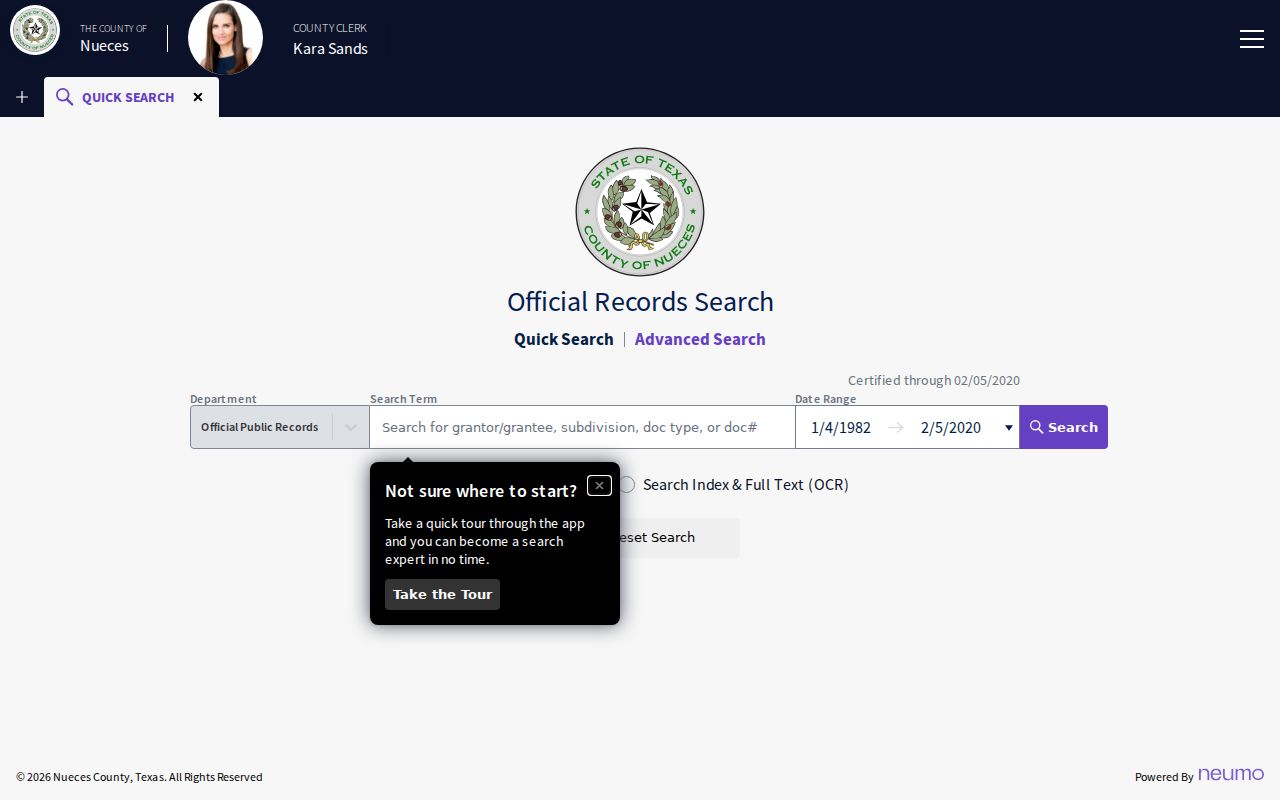
The official-record search image below documents the current search interface. Quick Search includes a search term, recorded-date fields, quick date buttons, and index-only or index-and-full-text OCR options; it does not make the current online coverage start year certain.
The historic path uses the Nueces Historic Index Books portal, where record type, year, Direct or Reverse party direction, and alphabetic name selections shape the search. That distinct interface is why the historical and current searches should not be treated as one seamless database.
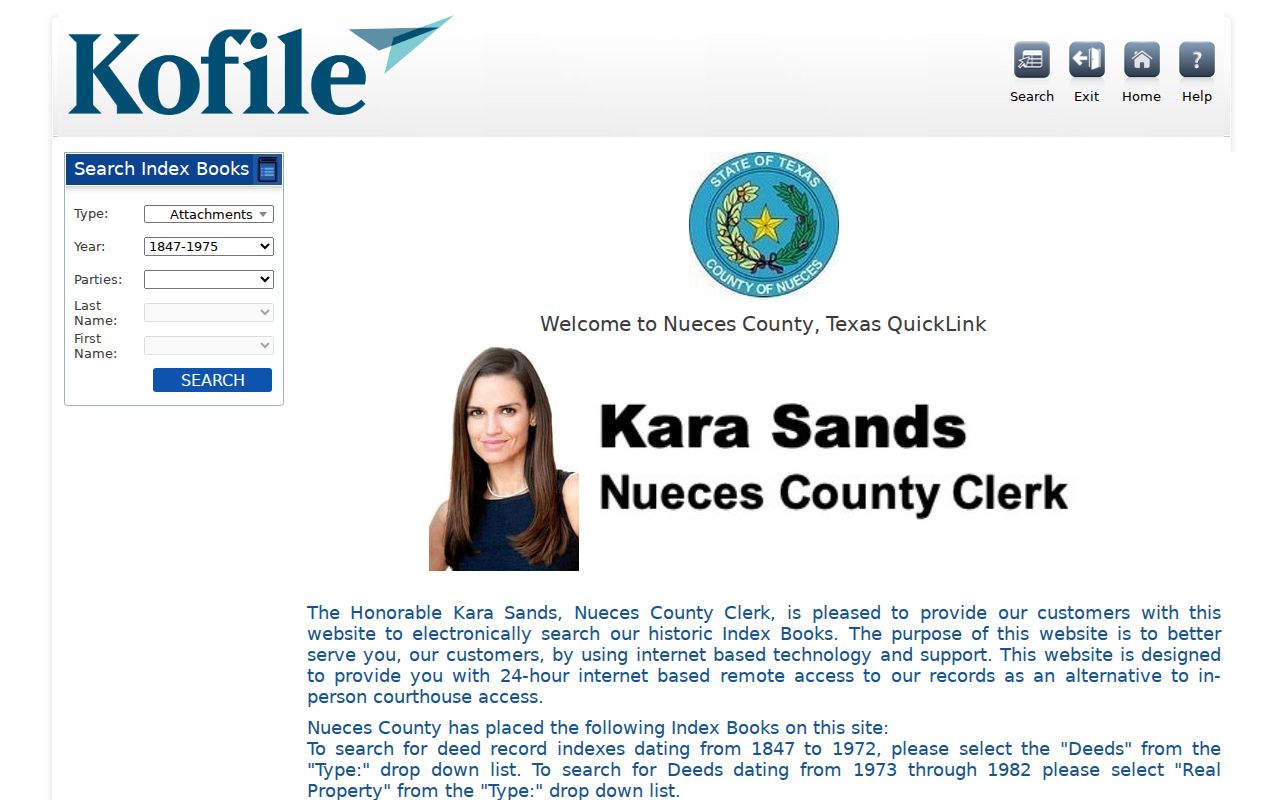
The County Clerk’s historic index includes deeds from 1847 and is part of a record trail that begins with Nueces County’s 1846 organization. This long span is useful, but a recording is evidence of an instrument, not proof that a named party lived at the address.
- Grantor / grantee
- The party transferring an interest and the party receiving it in a recorded instrument.
- Chain of title
- The documented sequence of transfers for the same tract, checked link by link.
- Legal description
- The lot, block, subdivision, tract, or metes-and-bounds wording that identifies land beyond a street label.
- Instrument placement
- The book/page, document number, or comparable recording reference needed to retrieve the clerk record.
Corpus Christi Previous Residents Library Trail
La Retama Central Library’s Local History Department provides the practical house-history layer when an address needs people, photographs, newspapers, maps, or older local context. Its second-floor collection includes city and telephone directories, yearbooks, funeral arrangements, family and individual files, business and organization files, city and county records, photographs, scrapbooks, and Caller-Times microfilm. Staff can help identify the likely directory volume, microfilm reel, obituary publication date, or Sanborn route.
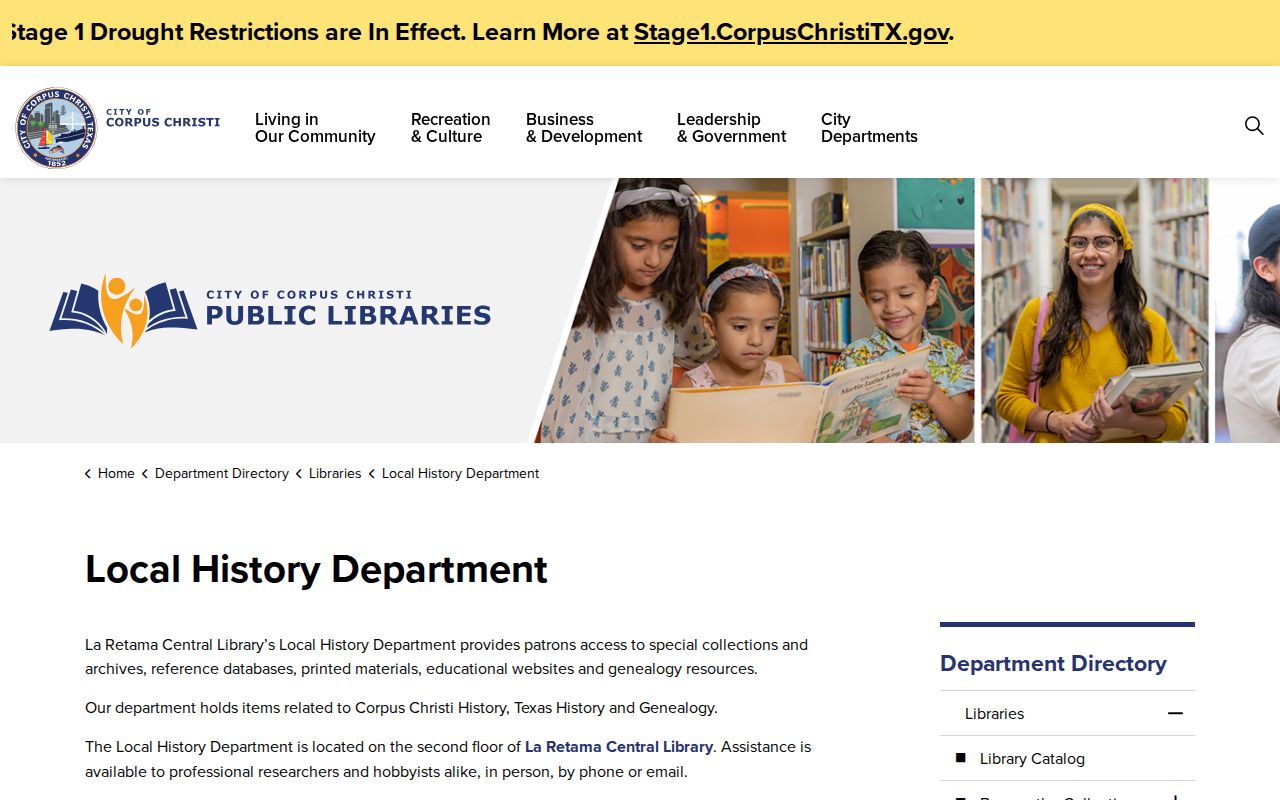
Fragile Local History material does not circulate. Black-and-white copies are 30 cents when copying is permitted, and staff directions may limit handling. Contact LocalHistory@CorpusChristiTX.gov or 361-826-7030 before a focused visit, especially when a specific volume or microfilm reel is needed.
The library is an evidence and interpretation resource, not a promise that every name has a searchable online result. The public CCPL history search offers obituary, special-collections, archives, and 1883-1903 entry points, while some affiliated resources remain available only on designated library computers.
Corpus Christi Previous Residents Building Context
Building evidence can test a date in the ownership trail. The Corpus Christi Dynamic Portal can provide anonymous address searches for permits, inspections, comments, documents, and fees. Its public guidance does not establish a complete historical beginning year. An applicant, contractor, or inspection date can show that work was recorded at an address, but it cannot establish a complete household or prove title.
Sanborn maps add a different kind of evidence: building footprints, lot relationships, uses, outbuildings, and street names. The Library of Congress Sanborn Maps collection and CCPL TexShare access are the documented routes. Exact Corpus Christi sheet years were not verified, so check the sheet date before attaching it to an era. Pair any map observation with the deed legal description and permit record.
The WPA Corpus Christi City Guide, Parts I and II, appears in a University of Texas finding aid for 1935-1945 records. It is civic-geography context, not a resident list, but it can clarify a street, institution, or missing address beside a dated directory entry.
Corpus Christi Previous Residents Household Trail
Owners are only part of the past resident record. A reverse or criss-cross directory can work from street number to a listed subscriber or household clue, and a standard directory may give a name, spouse or relative notation, occupation, residence/business section, street address, and cross-reference. Those are verification checkpoints, not asserted fields from every Corpus Christi volume. The underlying collections have different publishers, years, and access limits, so use the Corpus Christi city directory page for the collection details.
- Find the newest available directory or telephone-book entry for the address and copy the spelling, initials, street form, and section type.
- Move to an earlier listed run, allowing for initial changes, married-name changes, and directory lag.
- Search any reverse or criss-cross section by address, then state clearly whether it identifies a subscriber, business contact, or household clue.
- Pair that directory year with the nearest federal census released under the National Archives 72-year rule.
- Compare the household timing with a deed date, permit date, or recorded legal-description change before concluding the address is continuous.
Corpus Christi directory runs are scattered rather than uninterrupted: the Texas State Library list includes 1913-14, 1923-24, 1929, selected volumes through 1953, 1955-1986 except 1970, and 1987-1993. A January 1911 directory and 1909-1991 telephone-book runs are cataloged separately. Do not collapse them into one annual series.
Note: A dated directory entry can be a telephone subscriber or business contact, so pair it with independent evidence before treating it as a full household record.
Corpus Christi Previous Residents Endpoints
Obituaries and probate files can explain why a name disappears from an address trail. CCPL’s obituary index covers several hundred thousand Corpus Christi Caller, Times, and Caller-Times notices on microfilm, but it is arranged by publication date rather than death date. Start with a window around the likely notice date and check nearby publication dates. A probate file may add heirs, property references, notices, or addresses, subject to court access and redaction rules.
Can an obituary prove title? No. It can support family or date context, while the recorded deed supplies the title-chain evidence. Confirm a reported notice against the clerk’s instrument or probate record rather than using it as a substitute.
Corpus Christi Previous Residents Limits
Address history has breaks. Modern appraisal data, historical deed books, permits, directory snapshots, census schedules, maps, and newspaper notices use different units and cover different years. An older document may use a predecessor street label, subdivision name, or tract description. Official research did not identify a verified citywide renumbering or street-renaming year, so use plats, legal descriptions, historic directories, and maps to bridge a mismatch. A no-result in one portal is a reason to check the series and date range, not proof that the address had no earlier connection.
Lawful use. Use Corpus Christi previous-resident research for family history, property history, estate questions, or personal curiosity. Do not use a historic address trail to stalk, harass, or harm any living person.